Whitepaper
Moderate Tech solutions to Teacher Leaver's Workload, Lack of Peer Support and Grade Moderation Challenges
September 15, 2026
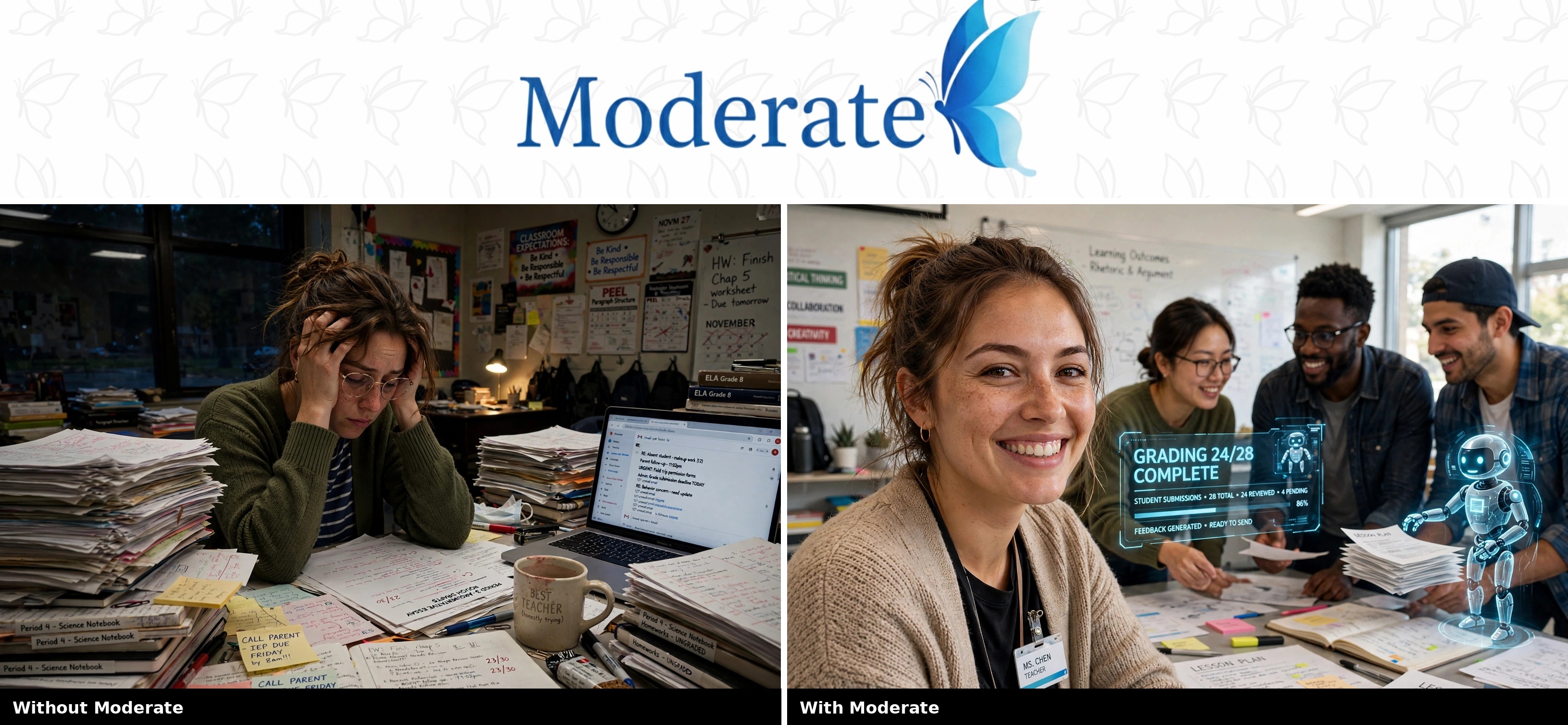
Teaching remains one of the few knowledge professions still largely practiced alone. A teacher's nearest professional peer is often down the hall, not across a subject, a school system, or a border — and that proximity limit is an accident of geography, not a reflection of who could actually help them most. Opening that up to peer-to-peer collaboration across institutions and countries is less a "nice to have" than a fix for a structural gap in how the profession currently works.
The OECD's 2013 Teaching and Learning International Survey (TALIS), covering over 100,000 teachers across 34 countries, found that while teachers consistently say they value collaborating with peers, most still work largely isolated within their own classrooms.(a) Academic research on "professional isolation" — a lack of access to peers, mentors, and outside perspective — links it to lower motivation, slower skill growth, and higher burnout risk, and finds the effect is worse for subject specialists who may be the only person teaching their subject in a building, and for teachers in rural or under-resourced schools. A more recent EU-funded study (b) (the VALIANT project) found that structured virtual exchange between teachers in different countries measurably reduced this sense of isolation, particularly for those in remote or otherwise disconnected settings.(c)
Further research on professional learning communities (PLCs) — structured, ongoing teacher collaboration — has repeatedly linked participation to improved teaching practice and measurable gains in student achievement; one hierarchical study across 26 elementary schools, 439 teachers, and roughly 11,000 students found statistically significant relationships between PLC participation and outcomes (d). Other case studies tie PLC-style collaboration to improved teacher retention. The underlying mechanism — structured peer exchange — produces results wherever it's tried(e).
Moderate is a truly global, interdisciplinary professional workplace that has all the tools an educator or teacher needs to interact with our Moderate PLC.
Grading: Becomes joint moderation and calibration — two teachers in different countries scoring a shared project against the same rubric, surfacing bias or drift in standards.
Moderation: Keeps subject forums and shared project spaces on-topic and safe once a network scales past a handful of trusted colleagues — the same function a community moderator serves, applied to an international staff room.
Individual chat: Enables 1:1 mentorship — a first-year teacher paired with an experienced peer abroad for quick, informal advice.
Group chat: Supports cohort-based exchange — every teacher in a subject or a multi-school partnership coordinating in one thread.
In-document comments: Turns lesson plans, rubrics, and curricula into living, co-authored documents, with feedback that stays attached and searchable over the life of a partnership.
Public announcements: Broadcasts network-wide opportunities — grant windows, calls for co-teaching partners, showcase results — to everyone at once.
Notifications: The retention mechanism that keeps slow, cross-time-zone collaboration alive; without it, international partnerships tend to fade for lack of urgency.
Additionally, with the advent of AI, the educational field has changed, workloads have increased alongside with student's use of AI to plagiarise. These have a dramatic effect on a teacher or educator's wellbeing, productivity and job-satisfaction.
Recent research found that over half (52%) of teachers considered leaving the profession in the last year due to marking, grading and moderating burdens[1]. On average a teacher spends about 8.2 hours per week just marking student work[2], often taking marking home (87% report doing so[2]).
Moderate Technologies solutions can help alleviate this burden and increase institutional staff retention by enabling teachers and educators to mark, moderate anytime, anywhere. Our AI Grader is also available for a fast second opinion and provides the educator with a report justifying the suggested grade. Marking is widely seen as one of the toughest parts of the job: 78% of teachers say grading is among the hardest tasks, and 67% report that marking demands have increased in the past year[3]. This overload contributes directly to stress and burnout: reducing grading work is the top way teachers (52%) believe they could lower stress and improve work-life balance[4].
At the same time, schools follow rigorous moderation processes to ensure consistency in grading. For example, consensus moderation involves groups of teachers meeting to align their marking standards[5]. Internal moderation (where multiple teachers within a school compare marks) and external moderation by exam boards are standard in UK secondary education[5][6]. Crucially, these moderation sessions often take place after normal school hours and involve multiple schools. In practice, teachers must travel (sometimes across districts) to spend full days “poring over rubrics” with colleagues from other schools[7]. As one industry analysis notes, traditional moderation meetings “are time-consuming, expensive in terms of disruption, cover and travel”[7].
The monetary cost of these activities is significant.
Every day a teacher spends in a moderation meeting typically requires a paid supply teacher to cover their classes, plus mileage or travel costs. Covering a single teacher’s full teaching day can cost on the order of a few hundred pounds[7]. When multiplied across departments and schools, the annual cost of moderation-related cover and travel runs into the thousands. Moreover, teachers are effectively working unpaid overtime when they stay late for moderation meetings, which adds to fatigue and turnover. As one trust leader put it, in-person standardisation “leads to immense disruption and additional workload” and rarely even achieves better consistency[7].
Impact on Burnout and Wellbeing
The cumulative effect of long hours, marking burdens, and extra moderation duties is a workforce in crisis. In recent surveys, high workload is cited as the single most important reason teachers plan to leave. For example, 94% of teacher-leavers said workload was a key factor in their decision[8]. Stress and burnout are pervasive: in a 2025 wellbeing index, 76% of teachers described themselves as stressed, and over one third of education staff are at risk of “probable clinical” mental health problems (due to workload, exhaustion and related factors)[9]. Furthermore, many teachers report losing sleep over marking. In a 2025 survey, 34% of teachers admitted they “lose sleep” due to grading[9], and a similar proportion feel overwhelmed or exhausted by marking (35% and 42%, respectively[10]).
Moderation duties add to this strain. Teachers often arrive home late after moderating with peers from other schools, then must compensate by spending more time the next day catching up or completing marking. Being pulled out of school to attend external meetings can also mean extra travel time in the evenings or weekends. The opportunity cost of this extra time is high: as educators point out, it “adds to their work day, contributing to burnout”[5][7]. In short, the double burden of grading and moderation duties is a key driver of teacher exhaustion across the UK.
Time and Cost of Grading
Even without moderation, grading is a huge time sink. Teachers mark every assignment, exam and project by hand, often using detailed rubrics. Research shows UK teachers routinely put in well over the contracted hours, spending evenings and weekends on marking. For perspective, a Department for Education survey found secondary teachers work nearly 50 hours per week on average (term time), yet only ~19 hours are spent in class; the rest is planning, marking and administration[11]. Much of that time is devoted to marking student work.
One study illustrates the toll: over 78% of teachers say grading is one of their toughest tasks[3]. On average, “teachers spend 8.2 hours a week marking assignments”[2]. Nearly 90% report feeling constant time pressure and taking marking home.
AI solutions can dramatically cut this time. For example, large-scale trials of automated essay scoring systems (used in higher education) report up to 90% reduction in grading time[12]. In one multi-million student study, AI graders agreed with human scores 92% of the time[12]. These findings suggest that an AI “second-opinion” on each assignment could save teachers hours without significantly altering outcomes.
Broad Availability of AI and Academic Integrity
Meanwhile, new challenges emerge as technology advances. Today any student can use AI chatbots (like ChatGPT, Gemini, et al.) to generate essays, code or answers on demand. These tools are free and easy: a quick prompt can produce a complete homework answer. This makes it extremely hard for teachers to know if a submission is the student’s own work, AI-assisted or fully AI-generated. Educators are rightly concerned: studies show that without AI-detection assistance, teachers cannot reliably spot generated text. In fact, one report warns “we can’t reliably detect writing from AI programs like ChatGPT” and calls many detectors “little better than a random guess”[13].
However, AI-detection tools from Moderate Technologies Limited exist and are evolving quickly. Our AI detector and platform-integrated tools (e.g. AI Detector and AI Similarity) analyse writing patterns to estimate the likelihood of AI involvement. In practice, these tools provide a probabilistic “AI usage” score rather than a definitive verdict. All AI tools provided by Moderate Technologies Limited are intended to be adjutants to the educator or user. We have taken a human-centric approach, helping the educator remains and will always remain at the center of our mission.They must be used carefully (confirmed by a educator), but they give teachers a starting point.
It is evident that AI agents blur traditional notions of originality, there are technology tools to help: AI detectors that yield a % estimate of AI-written content, AI graders give teachers a starting point and AI similarity checkers that flag copied or closely paraphrased text. These tools are becoming widely adopted in schools to help maintain integrity[14][17].
AI Solutions in Education
The last few years have seen an explosion of AI-powered educational tools aimed at addressing exactly these problems.
Key Moderate Technologies features include:
- AI Grader: These tools analyze student submissions and suggest grades or feedback. Our Ai grader can save up to 90% of grading time” by handling routine scoring. In high-enrollment courses, AI graders have matched human marking with ~90–92% agreement[12]. They allow a teacher to quickly review and adjust scores rather than marking every point from scratch.
- AI Similarity Checker: Our tool incorporates neural networks to detect paraphrasing and ‘text similarity’, greatly speeding up cross-comparisons. Instead of manually checking for copy/paste, teachers can run all submissions through our AI similarity tool and focus only on flagged cases. Thus saving hours of manual document comparison.
- AI Detector: Similar to our AI Grader, our similarity tools scores how likely the submitted text was AI-generated. As an adjutant, they give a “red flag” for suspect work. Importantly, they work transparently and generate a report for each file or document submitted. Teachers can then investigate only those pieces with high AI scores, rather than hand-reviewing every test, exam, essay or document for AI cues.
-AI Transcriber: Analyses and extract handwritten text from over 100 languages into typeset text, creating a pdf of your student's written essays, tests, schoolwork or homework. These files can be shared, stored or used for further analysis by the aforementioned AI Adjutants.
All of these tools act as digital assistants or adjutants. A teacher using an AI grader effectively has a teaching assistant that does the first-pass marking. An AI similarity tool spots identical or similar answers so the teacher only needs to check a few matches. An AI detector highlights likely AI-generated answers for teacher review. Together, these tools save vast amounts of time and stress. A recent pilot at one UK trust found that using AI-based adaptive comparison reduced moderation effort “from days to minutes”[18] – an order-of-magnitude improvement.
Moderate’s Human-centric AI Approach
Moderate Technologies Limited offers an integrated suite of AI tools designed to leverage these advances for schools. Moderate’s AI Grader gives teachers a fast second opinion on any submission. Using natural language processing, it produces an initial grade and feedback commentary, including student’s strengths, weaknesses and recommendations for the grader. Teachers can then review or adjust this suggested grade, cutting down their marking time dramatically.
If the teacher notices two (or more) student submissions that look alike, Moderate’s AI Similarity Checker can quickly compare the documents. It uses semantic analysis (not just exact text matches) to highlight overlapping ideas or phrasing. This enables the teacher to confirm suspected plagiarism or coordinate grading when papers seem collusive, without re-reading entire essays.
Importantly, Moderate’s AI Detector provides a probabilistic AI-usage score for each submission. This gives a percentage likelihood that a text was AI-generated. While all AI detection has limitations (Turnitin itself advises caution and flags any result under 20% AI content[16]), even a rough indicator can help teachers focus their attention. For example, if a student’s exam shows an 80% AI probability, the teacher can review that case in detail. In contrast, essays with near-zero AI scores can be passed quickly.
Crucially, these Moderate tools are cloud-based and collaborative, letting teachers moderate remotely. Instead of gathering after-hours, each teacher can log in to the Moderate PC portal or smartphone apps and review colleagues’ work from school or home. In practice, this means no travel, no supply cover costs, and no late-evening meetings. The approach mirrors the successful AI-enabled model cited above: “teachers from different schools can participate at their convenience, from their own classrooms”[19]. In this way, Moderate turns the traditional consensus-moderation model on its head.
What once took a whole day of meeting now happens asynchronously online in a fraction of the time, without losing the valuable calibration benefit of comparing marks.
Benefits: Saving Time and Reducing Burnout
By automating the repetitive parts of grading and moderation, Moderate’s solution directly addresses teacher burnout. Teachers report that even seeing a suggested grade or feedback greatly speeds up marking. Combining the AI Grader with peer moderation via the platform means each teacher spends far less personal time on paperwork and travel. This frees them to focus on teaching, lesson planning and wellbeing.
In numerical terms, the gains are stark. Traditional moderation “was slashed from days to minutes” in one AI pilot[18]. Applying those lessons,
Moderate’s users can save hundreds of teacher-hours per year. For a department or school, this translates into thousands of pounds saved on cover and travel, and untold human benefits in morale.
Moreover, offering AI-backed assistance makes teachers feel supported. Research found that nearly 73% of teachers wanted AI tools to handle 50% of their marking tasks[20], and 52% believed that cutting marking duties in half would reduce stress[4]. In other words, teachers are eager for a “personal teaching assistant”.
Moderate’s platform delivers exactly that vision: a set of AI tools working alongside the educator, handling the drudgery and alerting them only when human judgement is needed.
Conclusion
The opportunity cost of in-person grade moderation is enormous: long evenings, extra travel, and financial expense – all contributing to teacher fatigue. At the same time, students have unprecedented access to AI-generated content, creating new verification challenges. Moderate Technologies’ human-centric and AI-complemented platform tackles these problems head-on. By providing remote moderation, automated AI-grading suggestions, AI-similarity and AI-detection reports, it saves time and money while maintaining grading integrity. The result is healthier workloads and better support for teachers.
With Moderate’s tools, every teacher can have their personal teaching assistant, ensuring consistent standards while improving the wellbeing of educators.
Sources
a) OECD, Teaching and Learning International Survey (TALIS) 2013, via EdWeek: https://www.edweek.org/education/survey-teachers-worldwide-seek-more-opportunities-for-collaboration/2014/06
b) European Commission, "Celebrating 20 years of eTwinning": https://school-education.ec.europa.eu/en/discover/news/celebrating-20-years-etwinning
c) VALIANT project, impact of virtual exchange on teacher isolation: https://ualresearchonline.arts.ac.uk/id/eprint/22842/7/
d) Backman, "Relationship Between Professional Learning Communities and Student Achievement in Elementary Schools" (BYU): https://scholarsarchive.byu.edu/etd/3945
e) Allied Market Research, Social Learning Platforms Market, 2024–2032: https://alliedmarketresearch.com/social-learning-platforms-market-A09903
[1] [2] [3] [4] [9] [10] [20] UK Teachers Struggling with Marking Workload, Study Finds
https://learnosity.com/edtech-blog/over-half-of-uk-teachers-considered-leaving-education-in-last-12-months-due-to-marking-workload/
[5] Ofqual report, numbered headings
https://assets.publishing.service.gov.uk/media/5df777a0e5274a08e626bd8a/International_moderation_review_-_Final.pdf
[6] cambridgeassessment.org.uk
https://www.cambridgeassessment.org.uk/Images/476534-insights-into-teacher-moderation-of-marks-on-high-stakes-non-examined-assessments-.pdf
[7] [18] [19] Trust-wide practical assessment moderation is now a reality
https://schoolsweek.co.uk/moderation-of-practical-assessments-at-scale-is-now-a-reality/
[8] Working lives of teachers and leaders: wave 2 summary report - GOV.UK
https://www.gov.uk/government/publications/working-lives-of-teachers-and-leaders-wave-2/working-lives-of-teachers-and-leaders-wave-2-summary-report
[11] What is happening with teachers' workloads?
https://epi.org.uk/publications-and-research/what-is-happening-with-teachers-workloads/
[12] How AI marking tools are transforming teacher workloads: Evidence from global implementation studies | Matada Research
https://matadaresearch.co.nz/ai-marking/
[13] [15] [16] Detecting AI May Be Impossible. That’s a Big Problem For Teachers. — NSF Institute for Trustworthy AI in Law & Society (TRAILS)
https://www.trails.umd.edu/news/detecting-ai-may-be-impossible-thats-a-big-problem-for-teachers
[14] [17] Top 10 AI writing tools and plagiarism checkers for teachers
https://www.asuprepglobal.org/news/ai-checker-for-teachers/